
Introduction
Pressure measurement is one of the most fundamental variables in industrial automation. From chemical processing and hydraulic systems to water treatment, semiconductor manufacturing, and data center liquid cooling, accurate pressure data directly influences product quality, operational safety, equipment reliability, and energy efficiency.
For decades, analog pressure gauges have been widely used due to their simplicity and affordability. However, as manufacturing moves toward Industry 4.0 and predictive maintenance, traditional mechanical gauges are increasingly unable to meet modern requirements for precision, repeatability, connectivity, and data intelligence.
Today’s digital pressure gauges do far more than display pressure values. Equipped with advanced sensing technologies, intelligent signal processing, automatic temperature compensation, and industrial communication capabilities, they provide engineers with highly accurate, real-time measurement data while enabling remote monitoring and predictive maintenance.
This article explores the engineering principles behind digital pressure gauges, explains why they consistently outperform analog gauges in demanding industrial environments, and provides practical guidance for selecting the right solution for high-accuracy applications.
Why Measurement Accuracy Matters
Pressure measurement errors may appear insignificant, but even small deviations can have major consequences in industrial processes.
A measurement error of just 0.5% may lead to:
- Reduced product consistency
- Higher energy consumption
- Pump cavitation
- Incorrect process control
- Equipment damage
- Unexpected production downtime
- Increased maintenance costs
For industries operating under strict quality standards—such as pharmaceuticals, semiconductor fabrication, food processing, and chemical manufacturing—measurement accuracy directly impacts regulatory compliance and production efficiency.
Reliable pressure measurement allows engineers to maintain stable operating conditions, detect abnormalities early, and make informed maintenance decisions before failures occur.
How Analog Pressure Gauges Measure Pressure
Analog pressure gauges operate through purely mechanical principles.
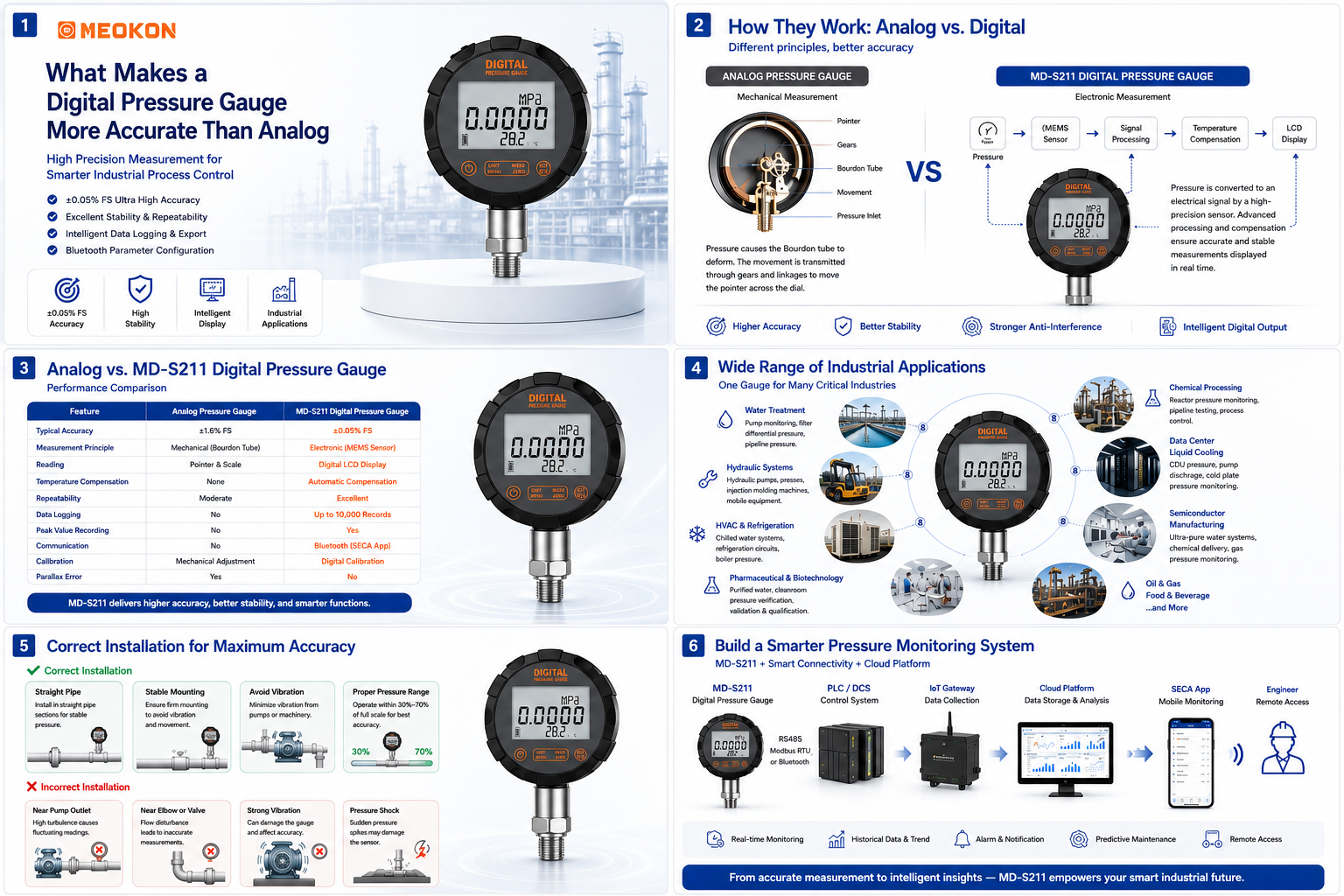
The most common design uses a Bourdon tube, a curved metallic tube that deforms when internal pressure changes.
The movement is transmitted through a series of gears and linkages, causing the pointer to rotate across a calibrated dial.
This simple design has proven reliable for decades, but it also introduces inherent limitations.
Common Sources of Error
Because analog gauges rely on mechanical components, their accuracy is affected by:
- • Mechanical wear
- • Spring fatigue
- • Gear backlash
- • Pointer vibration
- • Temperature expansion
- • Operator reading errors
- • Scale resolution limitations
As equipment ages, these mechanical effects gradually reduce measurement accuracy.
How Digital Pressure Gauges Measure Pressure
Unlike mechanical instruments, digital pressure gauges convert pressure into electronic signals using high-performance pressure sensors.
The measurement process consists of four stages:
A pressure-sensitive diaphragm deforms slightly under pressure.
Depending on the model, sensing technologies may include:
- • MEMS sensors
- • Diffused silicon sensors
- • Ceramic sensors
- • Single-crystal silicon sensors
The tiny deformation is converted into an electrical signal. Unlike mechanical motion, electronic signals can be measured with extremely high precision.
A built-in microprocessor continuously performs:
- • Temperature compensation
- • Zero correction
- • Linearity correction
- • Noise filtering
- • Digital calibration
These algorithms eliminate many of the inaccuracies found in traditional gauges.
The processed pressure value is displayed numerically and can also be transmitted through:
- • Bluetooth
- • RS485 Modbus RTU
- • Wireless communication
- • Industrial IoT gateways
- • SCADA systems
- • PLCs
- • Cloud platforms
Instead of serving as a standalone instrument, the digital pressure gauge becomes an intelligent node within a connected monitoring system.
Five Reasons Digital Pressure Gauges Are More Accurate
1. Advanced Pressure Sensor Technology
The sensor is the heart of every digital pressure gauge. Compared with mechanical Bourdon tubes, modern pressure sensors offer:
- • Higher sensitivity
- • Better linearity
- • Lower hysteresis
- • Superior repeatability
- • Minimal mechanical deformation
For high-end applications, single-crystal silicon sensors deliver outstanding long-term stability and ultra-low temperature drift.
2. Digital Temperature Compensation
Temperature is one of the largest sources of measurement error. Mechanical gauges cannot automatically compensate for environmental changes.
Digital pressure gauges continuously monitor internal temperature and use compensation algorithms to maintain stable accuracy across a wide operating range.
This feature is especially valuable for outdoor installations, refrigeration systems, and high-temperature industrial environments.
3. High-Resolution Signal Processing
Modern digital pressure gauges use high-resolution Analog-to-Digital Converters (ADCs) and powerful microprocessors to detect extremely small pressure changes.
Advanced filtering algorithms remove electrical noise while preserving genuine process fluctuations, resulting in smoother, more reliable readings. This level of signal processing is simply not possible with purely mechanical instruments.
4. Elimination of Mechanical Friction
Analog gauges rely on gears, springs, pivots, and pointers, all of which are subject to friction and wear over time. Digital pressure gauges significantly reduce these mechanical influences by relying on electronic sensing and processing.
The result is:
- • Improved repeatability
- • Better long-term stability
- • Lower maintenance requirements
- • Reduced calibration drift
5. Intelligent Diagnostics and Data Logging
Many modern digital pressure gauges go beyond real-time measurement by incorporating advanced diagnostic functions. These may include:
- • Historical data storage
- • Peak pressure recording
- • Trend analysis
- • Alarm notifications
- • Battery monitoring
- • Self-diagnostics
By continuously collecting and analyzing pressure data, digital gauges help maintenance teams identify developing issues before they result in equipment failures.
Analog vs. Digital Pressure Gauges – A Detailed Technical Comparison
Although analog pressure gauges remain suitable for basic pressure indication, they have several inherent limitations caused by their mechanical design. Digital pressure gauges, on the other hand, combine high-performance sensing technology with intelligent electronics to deliver greater precision, stability, and functionality.
The following comparison highlights the key differences.
| Feature | Analog Pressure Gauge | Digital Pressure Gauge |
|---|---|---|
| Measuring Principle | Bourdon tube with mechanical linkage | Electronic pressure sensor + digital signal processing |
| Typical Accuracy | ±1.6% FS | ±0.5%, ±0.25%, up to ±0.05% FS |
| Repeatability | Moderate | Excellent |
| Temperature Compensation | None | Automatic |
| Reading Error | Possible (parallax) | None (numeric display) |
| Vibration Resistance | Pointer oscillation | Digital filtering |
| Data Logging | No | Built-in memory (model dependent) |
| Peak Value Recording | No | Yes |
| Wireless Communication | No | Bluetooth, RS485, LoRa, etc. |
| Predictive Maintenance | No | Supported |
| Calibration | Mechanical | Digital calibration |
| Integration with PLC/SCADA | Not available | Available |
For facilities implementing Industry 4.0 strategies, digital pressure gauges provide measurable advantages in process visibility and equipment reliability.
Why High Precision Matters More Than Ever
As industrial processes become increasingly automated, pressure measurement is no longer limited to local indication. Pressure data is now used for:
- Closed-loop process control
- Predictive maintenance
- Equipment diagnostics
- Quality traceability
- Energy optimization
- AI-driven analytics
A pressure deviation that once went unnoticed may now affect automated production, trigger unnecessary alarms, or reduce overall system efficiency.
For example, in semiconductor manufacturing, a pressure deviation of only a few kilopascals can influence chemical delivery consistency. In data center liquid cooling systems, inaccurate pressure monitoring may delay the detection of pump cavitation or micro-leaks, increasing the risk of equipment downtime.
Introducing the MD-S211 High-Precision Digital Pressure Gauge
To meet the growing demand for high-accuracy industrial measurement, the MD-S211 High-Precision Digital Pressure Gauge has been engineered to deliver laboratory-grade performance in demanding field environments.
Designed for calibration, process verification, hydraulic testing, and precision monitoring, the MD-S211 combines advanced sensing technology with intelligent digital processing in a compact, robust instrument.
Key Advantages
Ultra-High Accuracy
The MD-S211 provides measurement accuracy of ±0.05% Full Scale (FS), making it suitable for applications where precise pressure control is critical.
Compared with conventional analog gauges, this significantly reduces measurement uncertainty and improves process consistency.
Excellent Long-Term Stability
A high-quality pressure sensor and intelligent compensation algorithms minimize long-term drift, reducing the frequency of recalibration and lowering maintenance costs.
This makes the MD-S211 well suited for continuous industrial use as well as calibration and verification tasks.
Large High-Definition LCD Display
The instrument features a clear digital display designed for excellent readability in both indoor and outdoor environments. Operators can quickly view:
- • Pressure value
- • Measurement unit
- • Battery status
- • Peak value (depending on configuration)
The numeric display eliminates interpretation errors associated with analog pointers.
Multiple Engineering Units
Industrial facilities often use different pressure units depending on regional standards and process requirements. The MD-S211 supports multiple selectable engineering units, helping engineers work efficiently without manual conversions.
Typical units include:
- MPa
- kPa
- bar
- psi
- kg/cm²
Robust Industrial Construction
Designed for harsh industrial environments, the MD-S211 features:
- • Stainless steel housing
- • Corrosion-resistant wetted parts
- • Shock-resistant construction
- • Long battery life
- • Low power consumption
Its rugged design supports reliable operation in manufacturing plants, hydraulic systems, water treatment facilities, and outdoor installations.
Typical Applications for the MD-S211
The versatility of the MD-S211 makes it suitable for a wide range of industries.
Hydraulic Systems
Hydraulic equipment relies on stable operating pressure to ensure precise motion control and equipment protection.
Typical monitoring points include:
- • Hydraulic pumps
- • Hydraulic presses
- • Injection molding machines
- • Mobile hydraulic equipment
- • CNC machinery
The MD-S211 enables engineers to quickly identify pressure losses, pump wear, and valve abnormalities before they develop into costly failures.
Water Treatment Plants
Pressure monitoring is essential throughout municipal and industrial water treatment processes.
The MD-S211 is commonly used for:
- • Booster pump monitoring
- • Filter differential pressure verification
- • Membrane testing
- • Pipeline pressure measurement
- • Pump performance evaluation
Accurate pressure data improves system efficiency while reducing unnecessary maintenance.
Chemical Processing
Chemical production often requires maintaining pressure within narrow operating windows.
The MD-S211 provides stable measurements that support:
- • Reactor pressure monitoring
- • Pipeline testing
- • Process validation
- • Equipment commissioning
Its high precision helps improve product consistency and operational safety.
Pharmaceutical Manufacturing
Pressure verification plays an important role in pharmaceutical production, particularly in clean utilities and sterile processes.
- • Purified water systems
- • Cleanroom pressure verification
- • Sterilization equipment
- • Validation procedures
- • Process qualification
Its high accuracy supports GMP-compliant maintenance and quality assurance programs.
HVAC and Refrigeration
Heating and cooling systems require reliable pressure measurement to maintain energy-efficient operation.
Typical applications include:
- • Chilled water loops
- • Refrigeration systems
- • Boiler testing
- • Heat exchangers
- • Pump stations
Digital pressure measurement helps maintenance teams detect declining performance before it affects system efficiency.
Data Center Liquid Cooling
As AI computing and high-density servers become increasingly common, liquid cooling systems are playing a central role in modern data centers.
Accurate pressure measurement helps engineers monitor:
- • CDU operating pressure
- • Cold plate pressure
- • Pump discharge pressure
- • Pipeline integrity
- • Pressure holding tests
Combined with intelligent monitoring software, digital pressure gauges enable predictive maintenance and improve cooling system reliability.
Best Practices for Achieving Maximum Measurement Accuracy
Even the most advanced pressure gauge requires proper installation and maintenance to achieve optimal performance.
Choose the Correct Pressure Range
For the best resolution and long-term reliability:
- • Normal operating pressure should be approximately 30–70% of full-scale range.
- • Avoid selecting an oversized range simply for convenience.
- • Ensure adequate overpressure protection where pressure surges are expected.
Install at Appropriate Measurement Points
Avoid locations immediately downstream of:
- • Pumps
- • Elbows
- • Control valves
- • Sudden pipe diameter changes
These locations may experience turbulence that affects measurement stability.
Minimize Mechanical Vibration
Where vibration cannot be avoided:
- • Use vibration-resistant mounting methods.
- • Install pulsation dampeners if required.
- • Secure tubing and process connections.
Stable installation improves measurement repeatability and extends sensor life.
Perform Regular Verification
Although digital pressure gauges require less maintenance than analog instruments, periodic verification remains important. Recommended maintenance includes:
- • Zero-point checks
- • Calibration verification
- • Battery replacement
- • Inspection of process connections
- • Review of historical pressure trends
A preventive maintenance strategy helps maintain long-term accuracy while reducing unexpected failures.
Frequently Asked Questions
Are digital pressure gauges always more accurate than analog gauges?
In most industrial applications, yes. Digital pressure gauges typically provide significantly higher accuracy, improved repeatability, and better resistance to temperature changes and mechanical wear.
Why is ±0.05% FS important?
An accuracy of ±0.05% Full Scale greatly reduces measurement uncertainty, making it suitable for calibration, precision testing, laboratory work, and critical industrial processes where even small deviations can impact quality or safety.
Can a digital pressure gauge replace an analog gauge?
Yes. In many applications, a digital pressure gauge can directly replace an analog gauge while adding benefits such as digital display, data logging, communication interfaces, and advanced diagnostics. Compatibility should be confirmed for pressure range, process connection, and environmental conditions.
Is the MD-S211 suitable for field use?
Yes. The MD-S211 is designed for industrial environments and combines high precision with a durable construction suitable for field inspections, commissioning, maintenance, and routine pressure verification.
Conclusion
The shift from analog to digital pressure measurement is driven by the growing demand for higher precision, better reliability, and smarter industrial operations. While analog gauges continue to serve basic indication needs, digital pressure gauges provide a clear advantage in applications where accuracy, repeatability, and data accessibility are critical.
The MD-S211 High-Precision Digital Pressure Gauge exemplifies this evolution by combining ±0.05% FS accuracy, intelligent digital processing, and a rugged industrial design. Whether used for hydraulic testing, water treatment, pharmaceutical validation, chemical processing, or data center liquid cooling, it helps engineers improve process control, reduce maintenance costs, and build a stronger foundation for predictive maintenance.
As industrial facilities continue their transition toward Industry 4.0 and Industrial IoT, investing in high-precision digital instrumentation is no longer simply an upgrade—it is a strategic step toward greater operational efficiency, improved product quality, and long-term reliability.
Post time: Aug-04-2026