
Logistics parks span vast areas with extensive fire suppression networks, yet most still rely on manual gauge checks and isolated control systems. A pressure drop in a remote fire main or a silent failure in a standby pump can go undetected for weeks. For facility managers and fire protection engineers, the challenge is no longer about buying the right hardware—it is about creating a connected, data-driven monitoring ecosystem that covers every corner of the park.
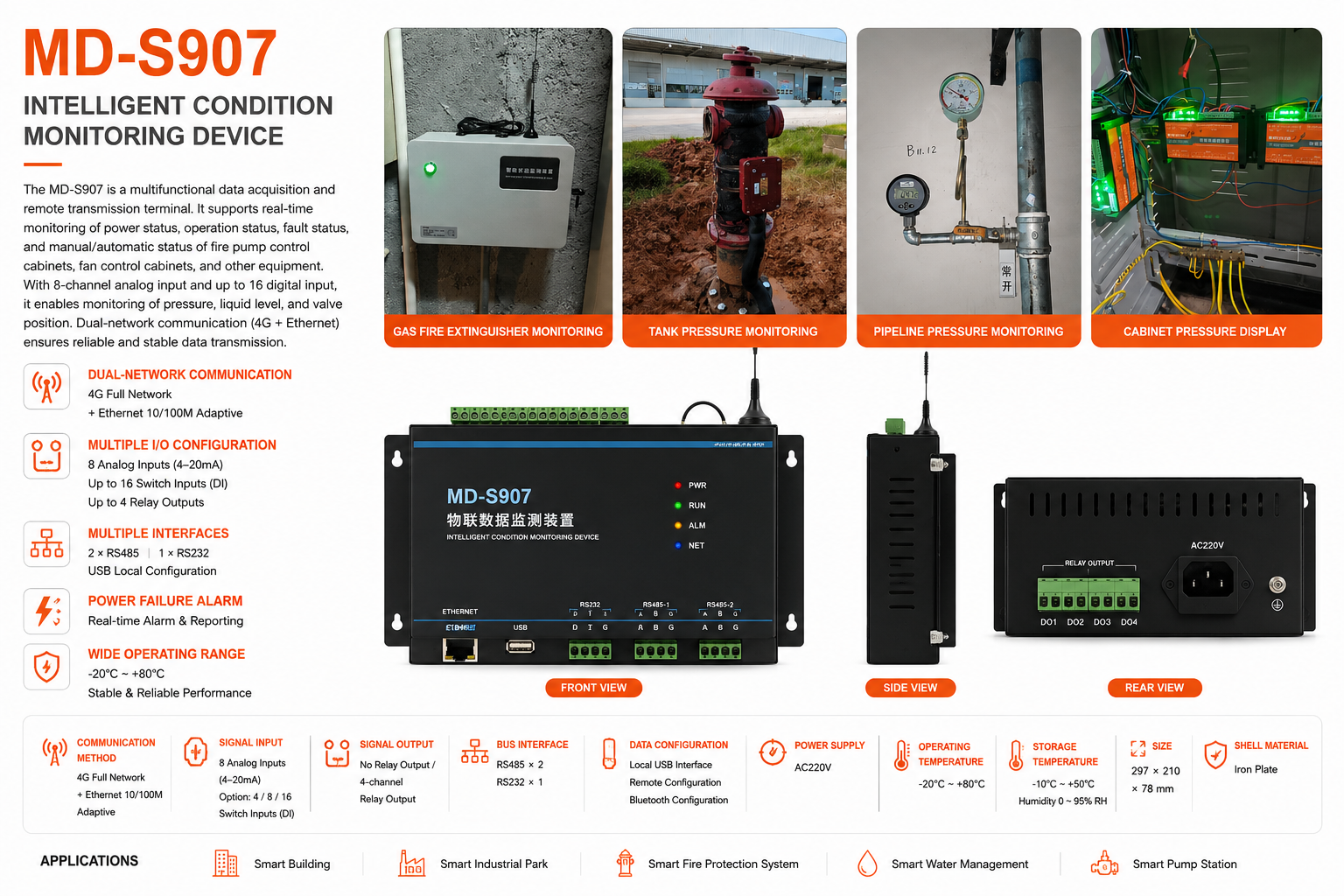
This article examines how a coordinated suite of IoT devices—MD-S272 wireless digital pressure gauge, MD-S273 outdoor wireless digital gauge, MD-S907 IoT data monitoring device, and MD-S909P intelligent condition detection device—forms a complete smart fire protection renovation solution for logistics parks, enabling real-time fire logistics park monitoring, firefighting IoT integration, and wireless fire pressure monitoring across the entire facility.
Key Takeaways
- Eliminates monitoring blind spots: MD-S272 and MD-S273 provide continuous, wireless fire water pipeline monitoring across the park, with configurable alarm reporting intervals from 10 minutes to 24 hours.
- Makes equipment status visible: MD-S909P’s 16 DI channels and 8 analog inputs monitor pump and fan control cabinets in real time, turning invisible standby failures into actionable alerts.
- Enables remote control: MD-S907′s 4 relay outputs allow operators to start/stop pumps and fans remotely, with dual communication paths (4G/NB + RS485) ensuring command reliability.
- Unifies fragmented systems: Multi-protocol gateways and diverse wireless options (LoRa, 4G, NB-IoT, LoRaWAN) break down data silos and feed a single smart fire protection management platform.
Technical Architecture: How the Solution Works
The solution is built on a layered IoT architecture: field sensing, edge data acquisition, wireless transport, and platform-level visualization. Each layer is addressed by one or more of the four devices.
Layer 1 Wireless Pressure Sensing (MD-S272 & MD-S273)
The MD-S272 wireless digital pressure gauge and MD-S273 outdoor wireless digital gauge measure fire main and terminal pressure at strategic points. Both use high-stability pressure sensors with digital signal conditioning, converting analog pressure into calibrated digital values.
- MD-S272: Supports multiple wireless protocols—LoRa, 4G, and NB-IoT—allowing selection based on local network coverage. It transmits data at configurable intervals (10 minutes to 24 hours) and supports high/low pressure alarms and fluctuation alarms.
- MD-S273: Designed for outdoor deployment with a cast aluminum housing and IP67 protection rating. Operating temperature range is -10°C to 60°C, and it runs on battery power for extended periods. Like the S272, it supports 4G, NB, LoRa, and LoRaWAN transmission modes.
Both devices output data to a fire IoT gateway, which aggregates readings from multiple sensors and forwards them to the central platform.
Layer 2 Intelligent Condition Detection (MD-S909P)
The MD-S909P intelligent condition detection device serves as a multi-channel data acquisition terminal. Its specifications include:
- 16 digital input (DI) channels: Monitor power status, running status, fault status, and manual/auto mode of fire pump and fan control cabinets.
- 8 analog input (4-20mA) channels: Monitor pressure, liquid level, and valve opening simultaneously.
- Dual-network communication: 4G + Ethernet ensures data continuity even if one network path fails.
- Bus interfaces: 2× RS485 and 1× RS232 allow connection to legacy instruments and third-party sensors.
Layer 3 Remote Control (MD-S907)
The MD-S907 IoT data monitoring device provides 4 relay outputs for remote control of water pumps and fans. It supports 4G/NB and RS485 dual communication, so control commands are delivered reliably even in areas with weak cellular signal. The device reports back the control status, creating a closed-loop verify-execute cycle.
Layer 4 Platform Integration
All devices feed data into a smart fire protection management platform via gateways. The platform performs data aggregation, alarm management, historical trending, and compliance reporting, giving operators a unified view of the entire park’s fire safety posture.
Application Scenarios & Solutions
1. Fire Water Pipeline Pressure Monitoring Across the Park
The Challenge: A typical logistics park covers tens of hectares with an extensive network of fire mains, branch lines, and terminal outlets. Mechanical gauges at each node require manual rounds that may occur only once or twice per month. A slow leak or valve closure can reduce pressure below the design minimum without anyone noticing until a real fire occurs.
The Solution: Deploy MD-S272 units at key nodes—main risers, branch takeoffs, and remote terminal points. For outdoor exposed locations, use the MD-S273 with its IP67-rated housing. Set alarm thresholds based on the system’s design pressure (e.g., low alarm at 70% of nominal). The devices report at intervals tuned to the site’s risk profile—more frequent during high-activity periods, less frequent during normal operations. Any deviation triggers an immediate alert to the control room and the smart fire protection management platform.
2. Fire Pump and Fan Status Visibility
The Challenge: Fire pumps and exhaust fans in logistics parks are critical life-safety assets that sit idle 99.9% of the time. Mechanical interlocks and simple indicator lights on control cabinets provide only binary on/off information. Subtle faults—such as a failing contactor, a tripped thermal overload, or a control circuit breaker that has been accidentally switched to manual—go unnoticed until a test or an actual emergency.
The Solution: The MD-S909P connects to each control cabinet’s auxiliary contacts and analog sensors. Its 16 DI channels monitor power-on, run, fault, and auto/manual status. The 8 analog channels monitor supply pressure, tank levels, and valve positions. With dual-network (4G + Ethernet) connectivity, data streams continuously to the platform. Operators receive alerts for any state change—e.g., a pump that was in auto mode but has dropped to manual—allowing corrective action before a real event.
3. Remote Pump and Fan Control
The Challenge: In a fire emergency, seconds matter. If a fire suppressant pump is in a remote pump room and requires manual startup, the delay between detection and water delivery can be critical. Conversely, false alarms or maintenance activities may require rapid shutdown.
The Solution: The MD-S907 provides 4 relay outputs that interface with pump and fan control circuits. Operators can start or stop equipment from the central platform or a mobile app. The device confirms each command by reporting the actual relay state back to the platform. The 4G/NB + RS485 dual communication ensures that even if the primary cellular link is congested, the command reaches the device via the RS485 wired backup.
4. Unified Data Integration Across Fragmented Subsystems
The Challenge: A logistics park’s fire safety infrastructure typically comprises multiple subsystems—pressure monitoring, pump control, smoke extraction, gas detection—each from different vendors with incompatible protocols. The result is a collection of data silos that require separate interfaces and cannot be correlated for holistic analysis.
The Solution: The MD-S909P acts as a universal data collector, accepting inputs from pressure transmitters, liquid level sensors, temperature probes, and relay contacts through its mixed DI/AI interfaces and RS485/RS232 buses. The MD-S273 adds wireless coverage for remote or hard-to-wire locations. Both feed into a fire IoT gateway that normalizes data into a common protocol (e.g., MQTT or HTTP) for the smart fire protection management platform. This unification enables cross-system correlation—e.g., automatically triggering smoke extraction fan startup when a fire alarm activates in a specific zone.
Comparative Analysis: Traditional vs. IoT-Enabled Fire Protection
| Feature | Traditional Manual System | IoT-Enabled Solution (MD-S272/S273/S907/S909P) |
|---|---|---|
| Pressure Monitoring | Manual gauge reading (monthly/quarterly) | Real-time wireless monitoring (interval 10 min – 24 hr) |
| Alarm Response | Discovered during inspection or failure | Instant alert via high/low/fluctuation alarms |
| Equipment Status | Visual inspection of cabinet indicators | 16 DI + 8 AI channels for comprehensive state visibility |
| Control Capability | On-site manual operation only | Remote relay control (4 channels) with status confirmation |
| Data Integration | Siloed, vendor-specific systems | Multi-protocol gateway unifying all sensors on one platform |
| Outdoor Durability | Standard enclosures (IP54 or lower) | IP67 cast aluminum (MD-S273), -10°C to 60°C |
| Network Redundancy | Single-path wired only | Dual-network (4G + Ethernet / 4G/NB + RS485) |
Implementation Guidelines
When planning a logistics park smart fire protection renovation, consider the following steps:
- Site Survey and Node Planning: Map the entire fire water network and identify monitoring nodes—main risers, branch lines, terminal outlets, pump room suction/discharge, and remote storage areas. Plan sensor density based on risk level and pipeline length.
- Wireless Protocol Selection: Evaluate local network coverage. In areas with reliable cellular, use 4G models. For parks with existing LoRa infrastructure or where cellular is weak, deploy LoRa/LoRaWAN gateways with compatible sensor nodes. NB-IoT is suitable for low-bandwidth, wide-coverage deployments.
- MD-S909P Channel Allocation: Map each DI channel to a specific cabinet status signal (power, run, fault, auto/manual). Assign analog channels to pressure transmitters, level sensors, and valve positioners. Ensure the total channel count meets the site’s requirements with 10–15% spare capacity for future expansion.
- MD-S907 Relay Interfacing: Coordinate with the electrical contractor to wire relay outputs to pump/fan control circuits. Verify that the relay contact ratings (voltage, current) match the control circuit requirements. Implement interlock logic in the platform to prevent conflicting commands.
- Platform Configuration: Define alarm thresholds based on system design documents. Configure reporting intervals, alarm hysteresis, and notification rules (SMS, email, platform alert). Integrate with existing BMS or fire alarm systems if required.
- Commissioning and Validation: After installation, perform end-to-end testing—verify data transmission, alarm triggering, and remote control commands. Document baseline readings for each node to establish reference values for future anomaly detection.
Frequently Asked Questions (FAQ)
Q What wireless protocols are supported, and how do I choose?
The MD-S272 supports LoRa, 4G, and NB-IoT. The MD-S273 supports 4G, NB, LoRa, and LoRaWAN. Choose 4G where cellular coverage is strong and bandwidth needs are moderate. Choose LoRa/LoRaWAN for long-range, low-power deployments in areas with limited cellular infrastructure. NB-IoT is ideal for low-data-rate sensors where existing cellular IoT networks are available.
Q How does the MD-S909P handle power supply in remote locations?
The MD-S909P is designed for integration with local power infrastructure (typically 24 VDC or 220 VAC). For remote cabinet locations without convenient power, a solar-plus-battery kit or a dedicated power supply can be deployed at the cabinet site. The device’s dual-network design (4G + Ethernet) also allows flexibility in how data reaches the gateway.
Q Can the MD-S907 relay outputs handle inductive loads like pump motors?
The relay outputs are rated for control-level loads. For direct switching of inductive loads such as motor contactor coils, ensure the relay’s contact rating exceeds the inrush current. In most installations, the relay switches the control circuit (e.g., a contactor coil at 24 VDC), not the motor power circuit directly. Consult the device’s datasheet for exact contact ratings and coordinate with the electrical design engineer.
Q How is data security handled in the IoT communication?
All wireless transmissions use standard encryption protocols (TLS/SSL for 4G, AES-128 for LoRa). Device authentication is handled via unique IDs and secure key exchange during provisioning. The platform can be deployed on-premise or in a private cloud to ensure data sovereignty. Access control, audit logging, and role-based permissions are standard features for enterprise deployments.
Conclusion & Next Steps
A logistics park’s fire safety system is only as reliable as its weakest monitoring point. The MD-S272, MD-S273, MD-S907, and MD-S909P form a coordinated IoT layer that transforms fragmented, manual fire protection infrastructure into a connected, intelligent system. Wireless pressure sensing eliminates blind spots, multi-channel condition detection makes equipment health visible, remote relay control closes the action loop, and multi-protocol gateways unify everything on a single management platform.
For system integrators and facility managers planning a smart fire protection renovation, the next step is a site-specific feasibility assessment. Contact our engineering team to discuss your park’s layout, existing infrastructure, and connectivity options. We can provide a detailed deployment plan, device selection matrix, and sample units for pilot testing.
Post time: Aug-12-2026