
In the fields of metrology, experimental validation, and precision manufacturing, the integrity of data is paramount. A pressure measurement is not just a reading; it is a critical variable that can define the success or failure of a test, the quality of a product, or the safety of a process. The core challenge for engineers and technicians is ensuring that this data is not only accurate at the moment of calibration but remains stable and reliable over time, despite fluctuating environmental conditions and system noise. This is where a high-performance high-precision pressure transmitter becomes an indispensable component of any robust measurement system.
This article examines the MD-S101, a transmitter engineered to meet these exacting demands. We will explore how its core technical specifications—particularly its exceptional accuracy and temperature stability—provide a definitive solution for professionals in calibration, laboratory research, and advanced equipment manufacturing.
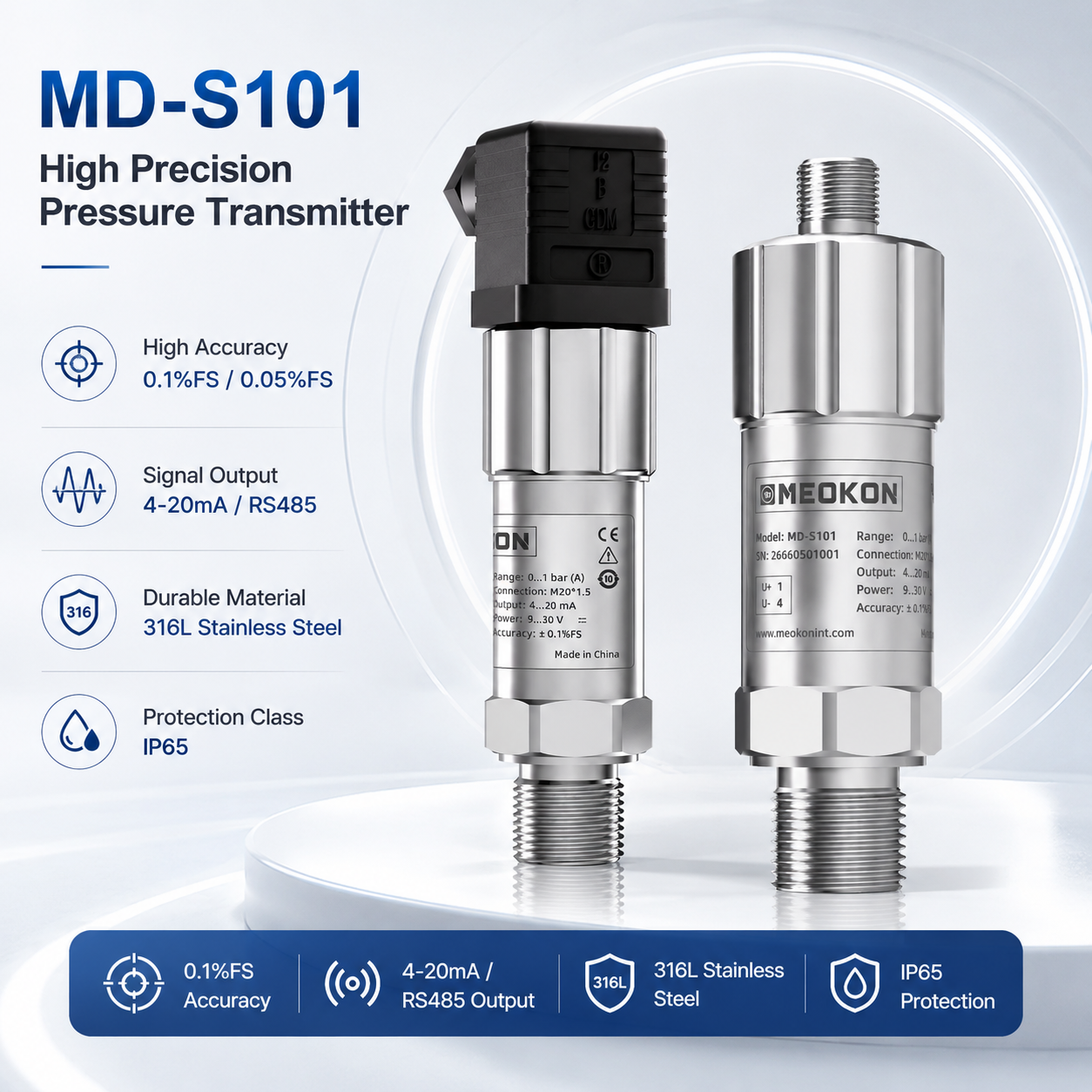
Key Takeaways
- Laboratory-Grade Accuracy: With standard accuracy of ±0.1% FS and an optional ±0.05% FS, the MD-S101 provides the fidelity required for reference-level measurements and high-stakes testing.
- Superior Temperature Stability: Advanced multi-point linear correction ensures minimal drift across a wide temperature range, a critical feature for non-climate-controlled industrial environments.
- Robust Signal Integrity: The combination of a 316L stainless steel housing and instrumentation-grade amplification offers strong anti-interference performance, ensuring clean data transmission in electrically noisy settings.
Technical Core: Engineering for Accuracy and Stability
The MD-S101 is designed from the ground up to address the primary sources of error in pressure measurement: sensor non-linearity, hysteresis, and, most significantly, temperature drift.
1. The Foundation: Single-Crystal Silicon Sensor Technology
At the heart of the MD-S101 is an imported single-crystal silicon sensor. This technology is chosen for its superior elastic properties and long-term stability compared to other sensing elements. It provides a highly repeatable and linear response to applied pressure, forming a reliable foundation upon which the transmitter’s high accuracy is built. This intrinsic quality is what allows the MD-S101 to achieve its standard accuracy of ±0.1% FS and its optional high-precision grade of ±0.05% FS.
2. Combating Temperature Drift with Advanced Compensation
Temperature variation is the most common cause of measurement drift in industrial and laboratory settings. The MD-S101 employs a sophisticated compensation strategy to mitigate this:
- Wide Temperature Zone Compensation: The transmitter is compensated over a broad operational temperature range of -20°C to 80°C.
- Multi-Point Linear Correction: During manufacturing, each unit undergoes a multi-point correction process. This ensures that the output signal is accurately adjusted across the entire compensated temperature range, not just at a single point.
The result is exceptional thermal stability. For the high-precision ±0.05% FS model, the temperature drift is specified as ≤±0.02% FS/10K within the 10°C to 60°C range. This level of performance is critical for applications like material testing or calibration work, where ambient temperature fluctuations must not compromise data integrity.
3. Ensuring Signal Integrity in Harsh Environments
In equipment manufacturing and industrial plants, electrical noise from motors, welders, and other machinery can corrupt low-level sensor signals. The MD-S101 is built to resist this interference.
- Instrumentation-Grade Amplifier: The internal signal conditioning circuitry is designed to provide strong anti-interference performance, ensuring that the output signal (whether 4-20mA or RS485) accurately represents the measured pressure.
- Rugged 316L Stainless Steel Construction: The entire housing, including the pressure port and diaphragm, is made from 316L stainless steel. This provides excellent corrosion resistance and a robust physical shield against environmental and electromagnetic interference. With an IP65 protection rating, it is also protected against dust and low-pressure water jets.
Applications & Solutions in Precision-Critical Industries
The technical capabilities of the MD-S101 translate into tangible benefits across several demanding sectors.
1. Metrology and Calibration Technology
For professionals in calibration labs or field service technicians, a pressure transmitter must serve as a reliable reference standard.
- The Challenge: Calibrating other instruments requires a device with significantly higher accuracy and stability than the unit under test. Drift or non-linearity in the reference transmitter invalidates the entire calibration process.
- The Solution: The MD-S101′s optional ±0.05% FS accuracy and excellent long-term stability (±0.1% FS/year) make it a suitable candidate for a working reference standard. Its built-in zero-point calibration function allows for quick and easy on-site adjustments, ensuring it remains in tolerance and streamlining the workflow for calibration technicians.
2. Research and Development Laboratories
In R&D settings, from fluid dynamics research to material science, capturing precise data is the core of the scientific method.
- The Challenge: Experiments can run for extended periods, and subtle changes in pressure are often the most important data points. A transmitter with poor thermal stability can introduce artifacts into the data, leading to incorrect conclusions.
- The Solution: The MD-S101′s superior temperature compensation ensures that the data logged over hours or days reflects actual changes in the experimental setup, not fluctuations in the lab’s ambient temperature. The RS485 digital output allows for easy integration into data acquisition systems, providing clean, noise-free data for analysis.
3. Equipment Manufacturing and Mechanical Engineering
OEMs building high-performance machinery, such as hydraulic presses or precision test stands, need components that ensure the quality and repeatability of their final product.
- The Challenge: A test stand used to validate the performance of manufactured parts is only as good as its sensors. Inconsistent pressure readings lead to inconsistent quality control, resulting in scrap or, worse, field failures.
- The Solution: Integrating the MD-S101 into test and measurement platforms provides a high level of confidence in the results. Its robust 316L stainless steel construction and strong anti-interference design ensure it can withstand the rigors of a manufacturing environment while delivering the precise data needed for reliable, repeatable quality assurance processes.
Comparative Analysis: Standard vs. High-Precision Transmitters
The following table highlights the operational differences between a standard industrial transmitter and the MD-S101 high-precision model in critical applications.
| Feature | Standard Industrial Transmitter | MD-S101 High-Precision Transmitter |
|---|---|---|
| Typical Accuracy | ±0.5% FS | ±0.1% FS (Standard) / ±0.05% FS (Optional) |
| Temperature Drift | Can be significant outside 25°C | ≤±0.02% FS/10K (for 0.05% model, 10-60°C) |
| Long-Term Stability | May require frequent recalibration | Excellent (±0.1% FS/Year) |
| Primary Use Case | General process monitoring | Calibration, R&D, Precision Test Stands |
Implementation Guidelines
When specifying the MD-S101 for your application, consider the following:
- ✅ Accuracy vs. Cost: For general process control, the standard ±0.1% FS model is exceptionally capable. Reserve the ±0.05% FS option for applications that serve as a reference standard or where the highest possible data fidelity is required.
- ✅ Output Signal: Choose 4-20mA for simple, point-to-point analog connections, which is ideal for PLCs and control systems. Select RS485 for digital communication, which allows multiple transmitters to be connected on a single bus and provides immunity to signal degradation over longer cable runs.
- ✅ Pressure Range: The MD-S101 is available in a wide variety of ranges, from vacuum to 100 MPa. Note that for the 0.05% accuracy model, the very lowest (0…0.025 MPa) and highest (0…100 MPa) ranges are not available.
- ✅ Process Connection: Ensure the transmitter’s thread type (e.g., G1/4, M20*1.5, 1/4NPT) matches your system’s requirements to avoid the need for adapters, which can introduce potential leak points and affect accuracy.
Frequently Asked Questions (FAQ)
What is the practical difference between the ±0.1% FS and ±0.05% FS accuracy models?
The choice depends on the required uncertainty of your measurement. The ±0.05% FS model offers twice the accuracy of the standard version. This is critical when the transmitter is used as a “golden unit” or reference standard to calibrate other, less accurate devices. In high-value R&D testing, this higher accuracy reduces the overall measurement uncertainty, providing greater confidence in the experimental results.
How does the MD-S101′s temperature compensation work in a real-world scenario?
Consider a hydraulic test rig in a factory where the temperature rises from 20°C in the morning to 35°C in the afternoon. A poorly compensated transmitter might show a false pressure increase of several percent due to this 15°C (or 1.5x10K) shift. With the MD-S101′s high-precision model (drift ≤±0.02% FS/10K), the error induced by this temperature change would be negligible (1.5 * 0.02% = 0.03% FS), ensuring the reading reflects the true hydraulic pressure.
Can the MD-S101 be used with corrosive media?
Yes. The MD-S101 is constructed entirely of 316L stainless steel for all wetted parts, including the housing, pressure port, and sensing diaphragm. 316L stainless steel offers excellent resistance to a wide range of chemicals, oils, and gases, making it suitable for many demanding industrial and laboratory media. It is always recommended to verify chemical compatibility for your specific fluid.
What is the benefit of the RS485 digital output over the traditional 4-20mA analog signal?
The RS485 output provides a digital signal that is immune to the signal degradation and electrical noise that can affect analog lines, especially over long distances. Furthermore, RS485 is a multi-drop protocol, meaning you can connect multiple MD-S101 transmitters (up to 99) on a single pair of wires, simplifying wiring and reducing installation costs in systems with many measurement points.
Conclusion & Next Steps
For applications where measurement uncertainty must be minimized, the choice of a pressure transmitter is a critical design decision. The MD-S101 high-precision pressure transmitter delivers the necessary combination of laboratory-grade accuracy, exceptional thermal stability, and robust construction to serve as a cornerstone of reliable data acquisition in calibration, R&D, and precision manufacturing.
Ready to specify a transmitter that ensures data integrity?
Contact our engineering team to discuss your application’s specific requirements. We can help you select the optimal accuracy, pressure range, and output signal for your project and provide a detailed quotation or a technical datasheet.
Post time: Sep-24-2026