
1. Introduction
Hydraulic pressure is one of the most important operating parameters in construction machinery. Excavators, loaders, cranes, concrete pumps, rollers, and other mobile machines rely on hydraulic pumps, valves, cylinders, and pipelines to convert fluid pressure into mechanical movement. When pressure changes are difficult to observe or record, troubleshooting often depends heavily on manual inspection and technician experience.
Engineering machinery digital pressure gauges provide a practical way to improve this process. The MD-S281 digital pressure gauge combines real-time pressure measurement, a 330° rotatable display, multiple pressure units, and Bluetooth connectivity. The MD-S151 miniature wireless pressure sensor focuses on compact installation and Bluetooth-based wireless pressure monitoring. (MEOKON)
For construction machinery manufacturers and maintenance teams, the two products can address different measurement requirements: MD-S281 is suitable for local pressure measurement, commissioning, inspection, and troubleshooting, while MD-S151 is better suited to compact or difficult-to-wire monitoring points.
Key Takeaways
- Use MD-S281 when technicians need direct digital pressure readings and convenient field inspection.
- Use MD-S151 where installation space is limited or wireless pressure transmission is preferred.
- Pressure data can support hydraulic-system troubleshooting, commissioning, preventive maintenance, and equipment performance evaluation.
- Product selection should be based on pressure range, medium compatibility, connection size, installation environment, communication requirements, and required data-management functions.
2. Technical Core: How Digital Pressure Monitoring Works
A digital pressure gauge converts pressure acting on a sensing element into an electrical signal and then processes that signal through an electronic conditioning circuit before displaying or transmitting the measured value. Compared with a conventional mechanical pointer gauge, the digital architecture makes functions such as unit conversion, zero adjustment, data communication, and electronic monitoring possible.
MD-S281: Local Digital Measurement with Bluetooth Connectivity
The MD-S281 uses a built-in high-precision pressure sensor for real-time pressure measurement. According to the available MD-S281 datasheet, its display accuracy options include ±0.5%FS and ±0.2%FS, with long-term stability better than ±0.3%FS/year. The dial can rotate through 330°, allowing technicians to adjust the viewing direction after installation.
For construction machinery, this is particularly useful because pressure ports are not always installed in an ideal viewing position. A rotatable display can make the pressure value easier to read during commissioning or maintenance.
The instrument supports multiple pressure units, including MPa, bar, PSI, kPa and other selectable units, together with zero reset, backlight, maximum/minimum pressure recording, and Bluetooth functions.
The MD-S281 also supports connection with the SECA application. The application can provide real-time data recording, device grouping, data export, customized device naming, and curve-based data presentation.
MD-S151: Compact Wireless Pressure Monitoring
MD-S151 takes a different approach. It is a miniature wireless pressure sensor/transmitter, designed for applications where a conventional instrument or wired installation may be inconvenient. MEOKON specifies a maximum height of 82.5 mm, Bluetooth transmission with a stated maximum distance of more than 20 m, and low-power battery operation. (MEOKON)
The device supports pressure-unit switching, zero clearing, high/low alarm settings, and fluctuation alarm thresholds. It can also be configured through Bluetooth and can work with a Bluetooth gateway for remote parameter configuration. (MEOKON)
This makes MD-S151 particularly relevant to compact hydraulic assemblies, test equipment, mobile machinery monitoring points, and locations where running additional communication wiring is undesirable.
3. Applications and Deep Solutions in Construction Machinery
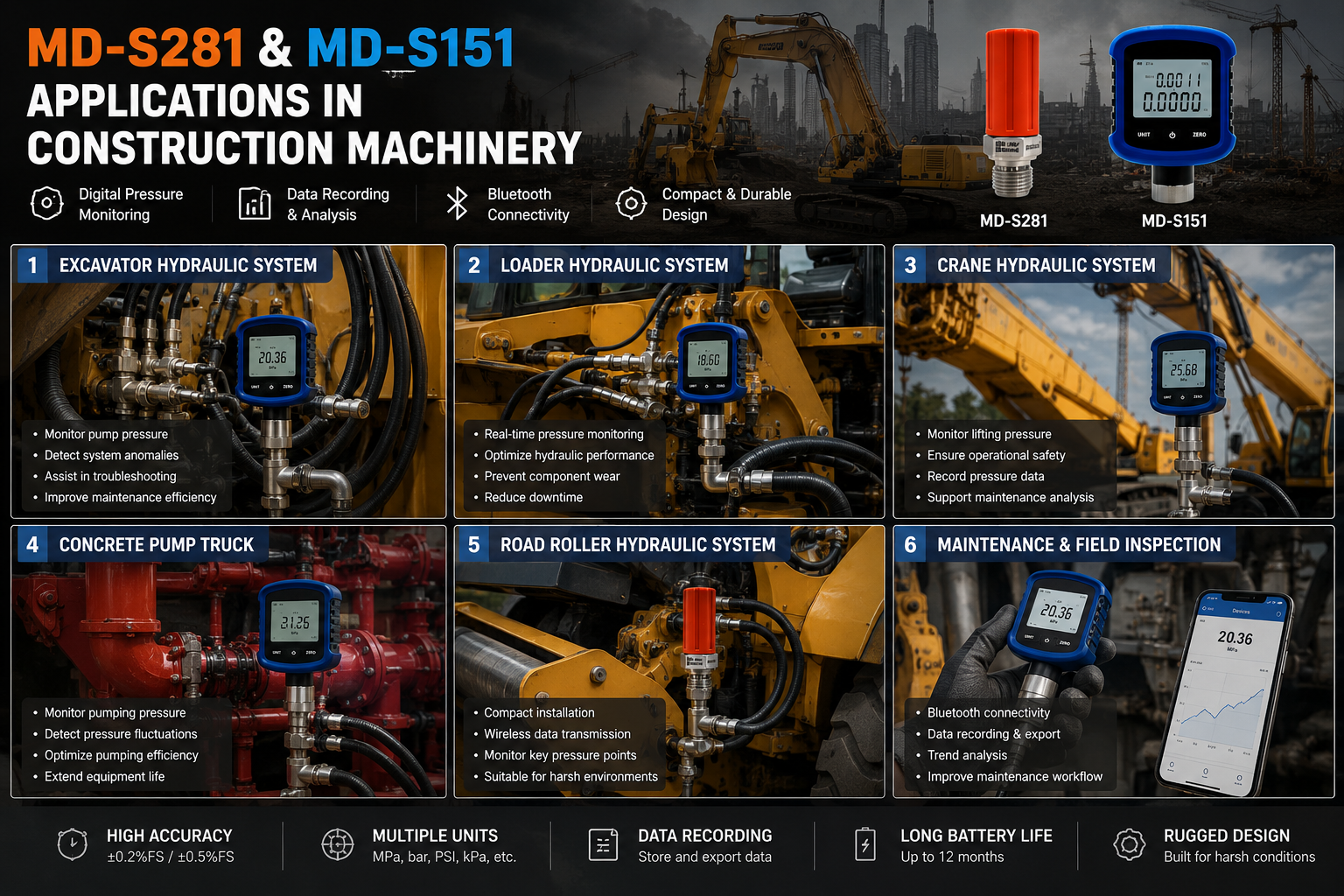
3.1 Excavator Hydraulic System Pressure Monitoring
Excavators contain multiple hydraulic circuits associated with the main pump, control valves, boom, arm, bucket, swing mechanism, and travel system.
During troubleshooting, engineers may need to determine whether abnormal machine movement is caused by insufficient pump pressure, valve problems, leakage, or actuator-related issues.
MD-S281 can be used as a temporary or semi-permanent inspection gauge at selected hydraulic test ports. Its digital display removes the need to estimate pointer positions, while Bluetooth connectivity provides an additional method for collecting measurement information.
Typical applications include:
- • Main hydraulic pump pressure inspection
- • Pilot circuit pressure measurement
- • Hydraulic valve commissioning
- • Cylinder circuit troubleshooting
- • Before-and-after maintenance comparison
For OEM testing, the same pressure point can also be checked under different operating conditions to compare idle, loading, and working-cycle pressure.
3.2 Loader and Hydraulic Powertrain Monitoring
Wheel loaders and similar equipment operate under rapidly changing loads. Hydraulic pressure can vary considerably during lifting, bucket loading, unloading, and steering operations.
A useful inspection strategy is to record pressure under defined operating conditions rather than relying only on a single static reading.
MD-S281 is suitable for field measurement and commissioning, while MD-S151 can be considered when a compact wireless sensor is needed at a measurement point with limited installation space.
Pressure measurements can help maintenance personnel identify:
- abnormal pressure drops;
- pressure fluctuations;
- differences between machines;
- changes before and after component replacement;
- possible hydraulic-system performance deterioration.
The pressure measurement itself does not diagnose the fault. It provides quantitative evidence that can be combined with flow, temperature, operating-cycle, and mechanical inspection results.
3.3 Crane and Lifting Equipment
Crane hydraulic systems have strict requirements for controlled movement and load handling. Pressure monitoring can be useful during hydraulic-system commissioning and maintenance.
For example, pressure can be checked at selected hydraulic circuits associated with lifting or supporting mechanisms. When the same test procedure is repeated periodically, historical measurements can provide a reference for maintenance personnel.
For difficult-to-access measurement points, MD-S151′s compact wireless configuration can reduce the need for additional communication wiring, while MD-S281 is more suitable when the technician needs to directly observe the pressure value at the measurement point. (MEOKON)
3.4 Concrete Pump Trucks and Pumping Equipment
Concrete pumping systems involve hydraulic power units, cylinders, valves, and associated hydraulic pipelines. Pressure behavior can change with pumping conditions and mechanical loading.
Digital pressure monitoring can be used during:
- • Hydraulic system commissioning
- • Pump maintenance
- • Valve inspection
- • Pressure comparison between operating cycles
- • Troubleshooting of abnormal hydraulic movement
The key advantage is not simply replacing a mechanical gauge with a digital display. The more important improvement is to turn pressure readings into structured maintenance information.
For example, a maintenance team can record pressure values at defined operating stages and compare them with previous service records. This creates a more objective basis for deciding whether additional inspection is required.
3.5 Road Rollers and Other Mobile Hydraulic Equipment
Road rollers and other compact construction machines often have limited installation space. Hydraulic components may also be located inside protective compartments or close to other mechanical components.
MD-S151 is relevant where a small-form-factor wireless pressure sensor is needed. Its compact dimensions and Bluetooth communication make it suitable for measurement points where conventional instruments are difficult to install or where temporary wireless measurement is preferred. (MEOKON)
MD-S281, meanwhile, is more appropriate for maintenance technicians who need a readable local display and flexible viewing direction.
Traditional Mechanical Gauge vs. Digital Pressure Monitoring
| Evaluation Point | Traditional Mechanical Gauge | MD-S281 / MD-S151 Approach |
|---|---|---|
| Pressure reading | Direct pointer reading | Digital numerical reading |
| Unit conversion | Usually requires separate gauge | Multiple units supported on MD-S281 |
| Viewing direction | Fixed dial orientation | MD-S281 supports 330° rotation |
| Data recording | Mainly manual | Bluetooth/data functions available on MD-S281 |
| Difficult installation points | May require direct visual access | MD-S151 supports compact wireless monitoring |
| Maintenance records | Manual recording | Digital data can improve traceability |
| Multiple measurement points | Technicians inspect points individually | Bluetooth-based monitoring can simplify selected measurement tasks |
| Troubleshooting | Strongly dependent on technician records | Provides more structured pressure information |
| Wiring requirement | Mechanical gauge itself needs no signal wiring | MD-S151 can provide wireless Bluetooth transmission |
| Best application | Basic local indication | Digital inspection, commissioning and selected wireless monitoring |
The table describes functional differences rather than guaranteed productivity or cost savings. Actual results depend on machine design, measurement points, communication distance, maintenance procedures, and operating conditions.
Practical Selection Recommendations
✅ Choose MD-S281 when local pressure visibility is the priority.
It is suitable for hydraulic test ports, commissioning, equipment inspection, and maintenance work where technicians need to read pressure directly.
✅ Choose MD-S151 for compact or difficult-to-wire measurement points.
Its miniature design and Bluetooth transmission are useful when installation space is limited or wireless data access is preferred. (MEOKON)
✅ Select the pressure range according to the actual hydraulic circuit.
Do not select a range simply because the maximum possible pressure appears acceptable. A suitable range should provide sufficient overload margin while maintaining useful measurement resolution.
✅ Confirm the measured medium.
For MD-S281, the available product information specifies compatibility with gas, liquid, and oil that are non-corrosive to stainless steel.
✅ Check process connection dimensions.
MD-S281 supports different connection configurations depending on the selected version, including M20 and other options. The actual connection should be confirmed against the hydraulic test port before procurement.
✅ Separate measurement from safety protection.
A digital pressure gauge should not automatically be considered a substitute for a hydraulic relief valve, safety valve, or machine control system. Pressure measurement provides monitoring information; protective functions must be designed according to the machinery’s safety architecture.
4. Frequently Asked Questions
Q: What is the main difference between MD-S281 and MD-S151?
MD-S281 is primarily a digital pressure gauge for local measurement and inspection, with a large display, 330° rotatable dial, multiple pressure units, and Bluetooth/data functions. MD-S151 is a miniature wireless pressure sensor/transmitter, emphasizing compact installation and Bluetooth transmission. (MEOKON)
Q: Can MD-S281 be used for excavator hydraulic pressure measurement?
Yes. MEOKON specifically lists construction machinery automation among its application areas, and its product information describes the MD-S281 as suitable for hydraulic pressure measurement. (MEOKON)
The final selection should still consider the hydraulic medium, pressure range, connection, temperature, and installation conditions.
Q: Is Bluetooth the same as remote monitoring?
No. Bluetooth generally provides short-range wireless communication between the instrument and a compatible mobile device or gateway. MD-S281 supports Bluetooth-based data access and configuration, while MD-S151 supports Bluetooth transmission and can work with a Bluetooth gateway. (MEOKON)
For true wide-area remote monitoring, an additional gateway or communication platform may be required.
Q: Can pressure data alone identify a hydraulic-system fault?
No. Pressure is an important diagnostic parameter, but it should normally be evaluated together with flow, temperature, machine operating conditions, valve status, actuator movement, and maintenance history. Digital pressure monitoring improves the quality and traceability of the measurement data; it does not replace hydraulic-system diagnosis.
5. Conclusion and B2B Selection Guide
Construction machinery requires pressure measurement that is not only readable but also useful for commissioning, maintenance, troubleshooting, and equipment management. MD-S281 provides digital local pressure measurement with 330° display rotation, multiple units, Bluetooth connectivity, and data functions, while MD-S151 provides a compact wireless option for measurement points where installation and wiring are more challenging. (MEOKON)
For OEMs, hydraulic-system manufacturers, service companies, and equipment maintenance teams, the appropriate solution should be selected according to the actual pressure range, medium, connection, installation space, communication requirements, and data-management objectives.
For OEM integration, hydraulic-system testing, or construction machinery pressure-monitoring projects, contact MEOKON’s engineering team to confirm the appropriate model, pressure range, connection, and communication configuration before procurement.
Post time: Sep-07-2026