
Introduction
Pressure is one of the most critical process variables in industrial automation. Whether operating hydraulic machinery, monitoring water treatment pipelines, managing HVAC systems, or maintaining fire protection networks, accurate pressure measurement directly impacts safety, efficiency, and equipment reliability.
However, selecting the right digital pressure gauge is no longer as simple as choosing a pressure range. Today’s industrial facilities demand instruments that not only provide precise measurements but also support intelligent diagnostics, remote monitoring, data logging, and seamless integration into Industrial IoT (IIoT) systems.
Modern digital pressure gauges have evolved from standalone indicators into smart sensing devices capable of supporting predictive maintenance, reducing manual inspections, and improving operational visibility. Wireless communication technologies such as Bluetooth, LoRa, NB-IoT, and 4G further extend these capabilities by enabling real-time monitoring without complex wiring.
This guide explains the key factors to consider when selecting a digital pressure gauge and highlights how MEOKON’s portfolio of digital and wireless pressure instruments can meet the needs of different industrial environments.
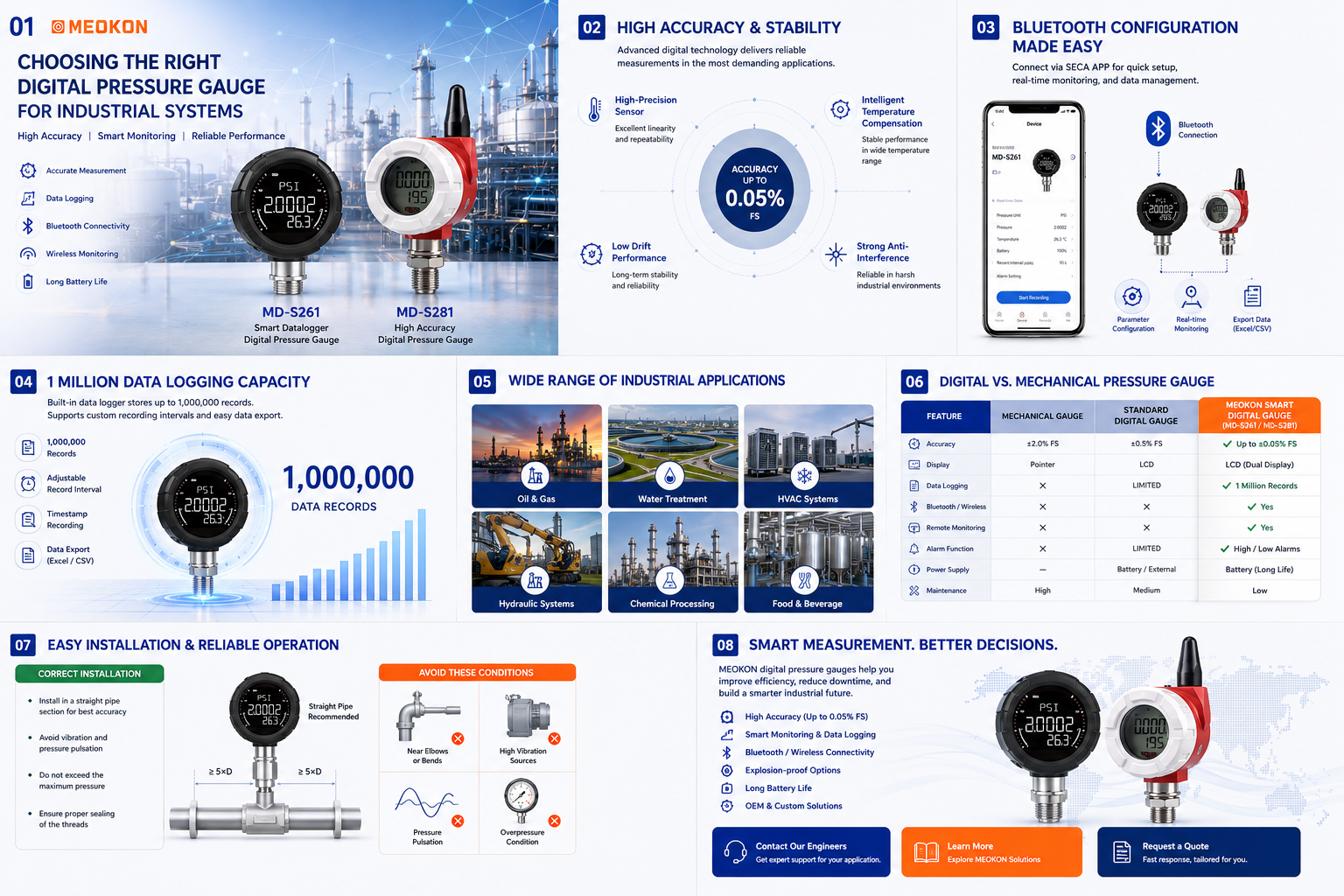
Why Choosing the Right Pressure Gauge Matters
Using an unsuitable pressure gauge can lead to more than inaccurate readings. It may result in:
- Reduced process efficiency
- Increased equipment wear
- Unexpected production downtime
- Higher maintenance costs
- Incorrect process control decisions
- Safety risks caused by pressure fluctuations
A well-matched pressure gauge provides accurate, stable measurements throughout its service life while reducing maintenance requirements and supporting long-term digital transformation initiatives.
Step 1 – Define Your Measurement Requirements
Before selecting a pressure gauge, engineers should clearly define the application requirements.
Important considerations include:
Pressure Range
Select a measuring range that allows normal operating pressure to remain between approximately 30% and 70% of full scale.
Oversized ranges reduce resolution, while undersized ranges increase the risk of overload.
Pressure Type
Industrial applications may require measurement of:
- Gauge pressure
- Absolute pressure
- Vacuum pressure
- Compound pressure
- Differential pressure
Choosing the correct measurement type ensures accurate process control.
Medium Compatibility
Consider the media being measured, such as:
- Water
- Hydraulic oil
- Compressed air
- Steam
- Chemicals
- Refrigerants
- Natural gas
For corrosive or aggressive media, select instruments with appropriate wetted materials, such as stainless steel or other corrosion-resistant components.
Step 2 – Determine the Required Accuracy
Accuracy requirements vary significantly between applications.
| Application | Recommended Accuracy |
|---|---|
| General Industrial Monitoring | ±0.5% FS |
| Hydraulic Systems | ±0.25% FS |
| Equipment Testing | ±0.1% FS |
| Calibration & Laboratory Applications | ±0.05% FS |
Higher accuracy reduces process uncertainty and improves repeatability, particularly in industries such as pharmaceuticals, semiconductors, and precision manufacturing.
Step 3 – Consider the Operating Environment
Industrial environments often expose instruments to challenging conditions.
Evaluate factors such as:
- Ambient temperature
- Humidity
- Mechanical vibration
- Dust
- Water ingress
- Corrosive atmosphere
- Electromagnetic interference
Selecting an instrument with an appropriate IP protection rating and rugged industrial construction helps ensure long-term reliability.
Digital Pressure Gauges vs. Wireless Digital Pressure Gauges
Although both provide accurate electronic pressure measurement, they serve different operational requirements.
Standard Digital Pressure Gauges
Standard digital pressure gauges are ideal for applications requiring local pressure indication, maintenance inspections, equipment testing, and calibration.
Typical advantages include:
- High measurement accuracy
- Large LCD display
- Multiple engineering units
- Peak value recording
- Data logging
- Low power consumption
These instruments are well suited for machinery manufacturers, laboratories, hydraulic systems, water treatment facilities, and process equipment.
Wireless Digital Pressure Gauges
Wireless digital pressure gauges extend monitoring capabilities by transmitting pressure data remotely without additional wiring.
They support technologies including:
- Bluetooth
- LoRa
- LoRaWAN
- NB-IoT
- 4G
This enables real-time monitoring across distributed industrial assets while significantly reducing installation costs. MEOKON’s wireless series also supports remote parameter configuration, alarm settings, and cloud connectivity for predictive maintenance.
When Should You Choose a Standard Digital Pressure Gauge?
A standard digital pressure gauge is the preferred choice when operators require:
- High-precision local measurements
- Portable testing equipment
- Equipment commissioning
- Pressure calibration
- Process verification
- Maintenance inspections
For example, the MD-S211 High-Precision Digital Pressure Gauge is designed for applications requiring exceptional measurement accuracy. It offers optional accuracy levels up to ±0.05% FS, a 330° rotatable display, Bluetooth parameter configuration, data logging and export, and low-power operation using AAA batteries or USB Type-C power.
Typical applications include:
- Hydraulic systems
- Pump testing
- Laboratory calibration
- Water treatment
- Manufacturing equipment
- HVAC commissioning
When Should You Choose a Wireless Digital Pressure Gauge?
Wireless pressure monitoring becomes especially valuable when:
- Measuring points are difficult to access
- Long cable installation is impractical
- Multiple locations require centralized monitoring
- Continuous remote supervision is required
- Predictive maintenance strategies are being implemented
Typical applications include:
Smart Water Networks
Monitor pipeline pressure continuously to detect leaks, pressure losses, and abnormal operating conditions.
Fire Protection Systems
Wireless gauges installed throughout fire water pipe networks enable remote status monitoring and alarm reporting while reducing manual inspections.
Petrochemical Plants
Monitor remote pipelines and storage facilities without extensive wiring infrastructure.
District Heating Systems
Continuous pressure monitoring improves energy efficiency while identifying system abnormalities before service interruptions occur.
Smart Manufacturing
Wireless pressure data integrates directly into cloud platforms and Industrial IoT systems, providing real-time visibility across production facilities.
MEOKON offers several wireless digital pressure gauges supporting Bluetooth, LoRa, LoRaWAN, NB-IoT, and 4G communication, allowing users to choose the most suitable solution based on communication distance, infrastructure, and deployment requirements.
Key Features to Look For
When evaluating a digital pressure gauge, consider the following capabilities.
High-Precision Sensor
A high-quality pressure sensor improves repeatability, minimizes drift, and enhances long-term stability.
Intelligent Temperature Compensation
Automatic compensation maintains measurement accuracy across varying ambient temperatures.
Data Logging
Historical pressure records support troubleshooting, trend analysis, and predictive maintenance.
Multiple Pressure Units
Selectable units simplify operation across international projects and industries.
Wireless Connectivity
Bluetooth, LoRa, and NB-IoT reduce installation complexity while enabling remote monitoring.
Alarm Functions
Configurable high and low pressure alarms allow operators to respond quickly to abnormal conditions.
Battery Life
Low-power design reduces maintenance frequency and supports long-term field deployment.
Typical Industrial Applications
Modern digital pressure gauges are widely used across many industries.
Water Treatment
- Pump monitoring
- Filter pressure measurement
- Pipeline pressure verification
Hydraulic Systems
- Hydraulic presses
- Injection molding machines
- Mobile hydraulic equipment
Oil & Gas
- Pipeline pressure monitoring
- Wellhead equipment
- Storage systems
HVAC
- Chilled water systems
- Refrigeration equipment
- Heat pumps
Fire Protection
- Fire water pipe networks
- Sprinkler systems
- Pump stations
Manufacturing
- Pneumatic systems
- Industrial machinery
- Production automation
Why Choose MEOKON?
MEOKON has developed a comprehensive portfolio of digital instrumentation designed for industrial automation, smart sensing, and Industrial IoT applications.
Its product range includes:
- High-precision digital pressure gauges
- Bluetooth digital pressure gauges
- Wireless digital pressure gauges
- Pressure transmitters
- Differential pressure sensors
- Flow meters
- Temperature sensors
- IoT gateways
- Smart monitoring platforms
Digital models such as the MD-S211 focus on high-accuracy local measurement and data logging, while wireless models including the MD-S270 and MD-S273 series provide remote monitoring through 4G, NB-IoT, LoRa, and LoRaWAN communications for smart industrial infrastructure.
Conclusion
Choosing the right digital pressure gauge requires balancing measurement accuracy, environmental conditions, communication requirements, and future expansion plans.
For applications focused on precision testing, calibration, or local process monitoring, a high-accuracy digital pressure gauge such as the MD-S211 provides reliable performance and advanced data management capabilities.
For distributed assets, smart utilities, fire protection systems, and Industrial IoT projects, wireless digital pressure gauges offer continuous remote monitoring, reduced installation costs, and valuable predictive maintenance insights.
By selecting the right pressure monitoring solution today, industrial facilities can improve operational efficiency, enhance equipment reliability, and build a smarter, data-driven future.
Post time: Aug-05-2026