
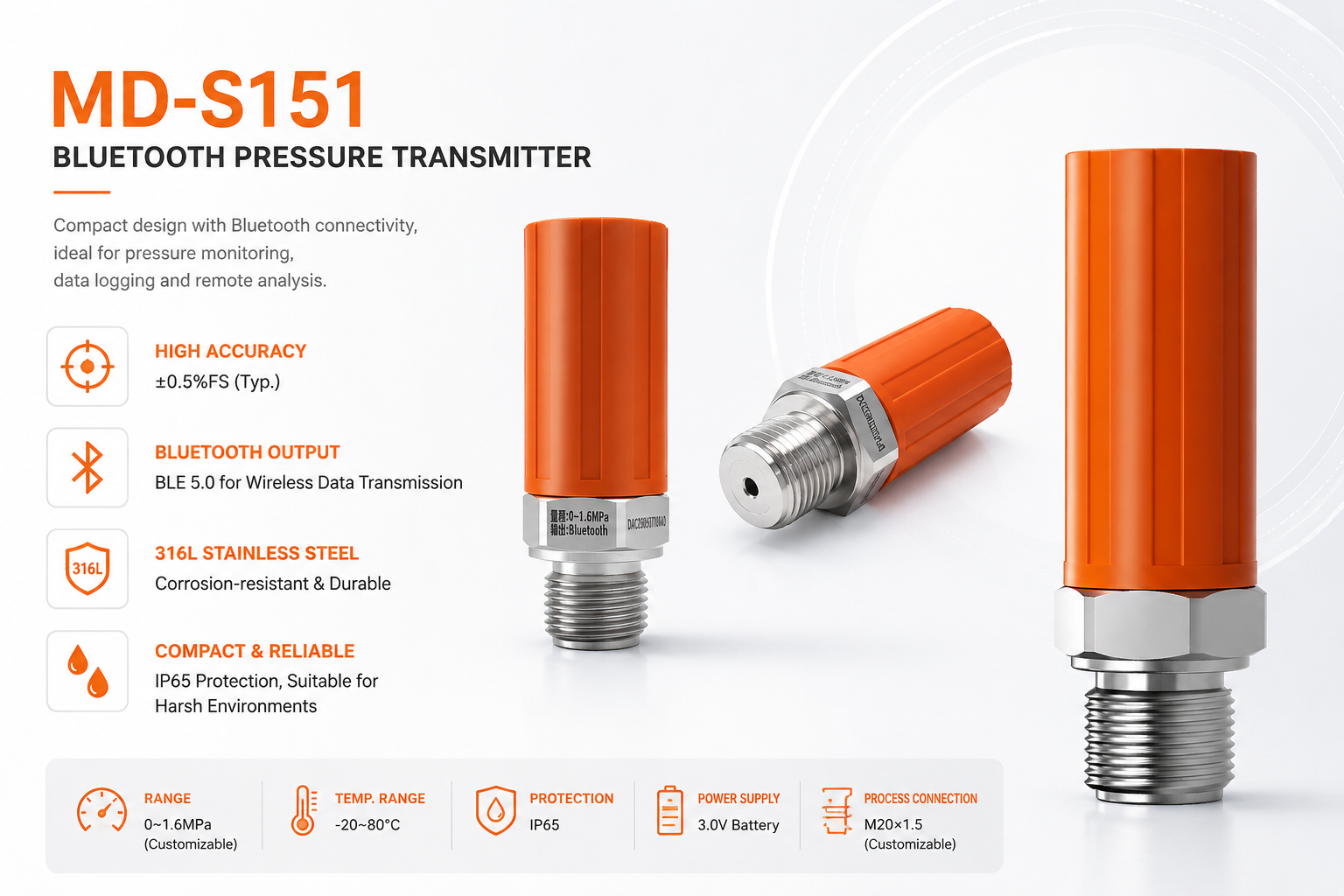
In the design of high-performance espresso machines, every millimeter of internal space is accounted for. Integrating accurate pressure monitoring into these compact systems has historically presented a significant engineering challenge. Traditional wired sensors require complex routing through tight chassis, adding assembly time, potential points of failure, and compromising the clean internal architecture that modern manufacturing demands. The MD-S151 ultra-small wireless pressure transmitter is engineered to solve this specific problem, offering a path to precise coffee machine pressure monitoring without the constraints of physical wiring.
This article explores how the MD-S151′s compact, wireless design provides a robust solution for engineers and manufacturers aiming to enhance machine performance and user insight.
 Key Takeaways
Eliminates Complex Wiring: The MD-S151′s wireless design removes the need for intricate cable routing within the confined spaces of a coffee machine, simplifying assembly and improving reliability.
Enables Real-Time Data Visualization: By transmitting data via Bluetooth, it allows for real-time monitoring of the espresso machine pressure profile on a mobile device, a critical feature for R&D and user engagement.
Optimized for Compact Integration: With a maximum height of just 82.5mm, this miniaturized pressure transmitter is specifically designed to fit into space-constrained applications where traditional sensors cannot.
Technical Core: Engineering a Wireless Monitoring Solution
The MD-S151 is not simply a sensor with a wireless module attached; it is a fully integrated system designed from the ground up for low-power, reliable data transmission in demanding environments. Its operation is based on the synergy of three core technical principles: precision sensing, digital signal conditioning, and efficient wireless communication.
1. The Sensing Element: Precision at the Source
At the heart of the device is a high-precision pressure sensor. This component converts the physical force of the hydraulic pressure within the coffee machine’s pump or brew group into a measurable electrical signal. The accuracy of this initial conversion is paramount, as it forms the foundation for all subsequent data. The MD-S151 is available with accuracy classes of 0.5% FS and 0.25% FS, providing the fidelity required for detailed analysis of the extraction process.
2. Signal Conditioning and Power Management
The raw signal from the sensor is processed by an onboard digital conditioning circuit. This circuit linearizes the signal, compensates for temperature effects, and prepares the data for transmission. A critical design challenge for any wireless device is power consumption. The MD-S151 addresses this with an ultra-low-power design, enabling it to operate for up to 12 months on a single battery. This is achieved through a combination of efficient circuitry and a low standby power consumption of <5uA, ensuring long-term, maintenance-free operation.
3. Wireless Data Transmission via Bluetooth
Instead of a 4-20mA or 0-10V wired output, the MD-S151 utilizes a Bluetooth transmission module. This allows it to send pressure data wirelessly to a receiving device, such as a smartphone or a dedicated gateway.
- Direct Mobile Connectivity: Technicians and users can connect directly to the sensor using a mobile app to view real-time pressure readings and configure parameters like units and alarm thresholds.
- Robust Communication: The Bluetooth module provides a reliable transmission distance of over 20 meters, which is more than sufficient for communication from within a machine’s housing to a user’s mobile device nearby.
This wireless architecture is the key differentiator, transforming the pressure transmitter from a simple component into an accessible data node within the machine.
Applications & Solutions in Coffee Machine Design
The technical capabilities of the MD-S151 translate into tangible benefits across the lifecycle of a coffee machine, from R&D and manufacturing to end-user operation and maintenance.
1. Streamlining R&D and Performance Tuning
For R&D engineers, understanding the dynamic pressure changes during an espresso shot is crucial for optimizing flavor extraction.
- The Challenge: Capturing a live espresso machine pressure profile with traditional sensors requires running wires out of the machine to a data logger, a setup that is cumbersome and does not reflect the machine’s final, enclosed state.
- The Solution: The MD-S151 can be installed in its final position, and engineers can use a tablet or phone to wirelessly monitor and record the pressure curve in real-time. This mobile Bluetooth pressure reading capability allows for rapid, iterative testing and tuning of pump profiles, pre-infusion stages, and solenoid valve timing without any physical disassembly.
2. Simplifying Manufacturing and Assembly
For Original Equipment Manufacturers (OEMs), assembly line efficiency and product reliability are top priorities.
- The Challenge: Routing and securing wires for a traditional pressure sensor is a manual, time-consuming process. These wires can be susceptible to damage, chafing against sharp chassis edges, or interference from other electrical components.
- The Solution: As a wireless pressure transmitter, the MD-S151 eliminates this entire wiring step. Its ultra-small form factor (max height 82.5mm) allows it to be mounted directly onto the pump or brew group in tight spaces. This no-wiring pressure sensor approach reduces assembly time, lowers labor costs, and removes a common source of field failures, thereby improving the overall quality and reliability of the final product.
3. Enhancing User Experience and Diagnostics
In the era of smart appliances, providing users with data and control is a significant market differentiator.
- The Challenge: For a barista or enthusiast, the brewing process is a “black box.” They can see the output but have no insight into the internal pressure dynamics that create the espresso.
- The Solution: Manufacturers can leverage the MD-S151′s Bluetooth connectivity to create a user-facing feature. A companion mobile app could allow users to view their extraction pressure profile in real-time, helping them perfect their technique. This level of transparency and control adds significant value for professional baristas and serious home users.
Comparative Analysis: Traditional vs. Wireless Integration
The following table contrasts the implications of using a traditional wired sensor versus the MD-S151 wireless solution in coffee machine manufacturing.
| Feature | Traditional Wired Sensor | MD-S151 Wireless Transmitter |
|---|---|---|
| Installation | Complex wiring and routing required | Simple, direct mounting; no wiring needed |
| Space Requirement | Sensor plus space for cable management | Ultra-compact (82.5mm max height) |
| Data Access | Requires hardwired connection to a display | Wireless via Bluetooth to any mobile device |
| Maintenance | Wiring is a potential point of failure | Battery-powered (12-month life); no wiring to fail |
Implementation Guidelines
When specifying the MD-S151 for a coffee machine application, consider the following:
- ✅ Pressure Range: Select the appropriate range for your system. For most espresso machines, a range that covers 0-15 bar (1.5 MPa) is typical. The MD-S151 offers a variety of ranges to suit different pump systems.
- ✅ Process Connection: Ensure the sensor’s thread type matches your machine’s pump or brew group. The MD-S151 supports standard connections like G1/4 and 1/4 NPT, which are common in fluid power applications.
- ✅ Media Compatibility: The pressure port is made of 304 Stainless Steel, which offers excellent compatibility with water and is suitable for the high-temperature, high-pressure environment inside a coffee machine.
- ✅ Accuracy Selection: For general monitoring, the 0.5% FS accuracy is sufficient. For detailed R&D and profiling where capturing subtle pressure changes is critical, the 0.25% FS model is recommended.
Frequently Asked Questions (FAQ)
How does the MD-S151 handle the high temperatures inside a coffee machine?
The MD-S151 has a specified operating temperature range of -5°C to 40°C. In a coffee machine, the sensor is typically mounted on the pump or a part of the hydraulic circuit where the water has not yet been heated to brewing temperature. This placement ensures the sensor operates within its specified thermal limits while still providing an accurate reading of the system pressure.
What is the battery life, and how is it replaced?
The MD-S151 is designed for low power consumption, with a battery life of up to 12 months under typical operating conditions. The device is powered by a standard, user-replaceable CR2032 battery. This design allows for easy maintenance without requiring specialized tools or service, minimizing downtime for the end-user.
Can the data from the MD-S151 be integrated into a larger IoT system?
Yes. While the MD-S151 can connect directly to a mobile phone for local monitoring, it is also designed for broader integration. By using an optional Bluetooth gateway, the data from one or more sensors can be aggregated and transmitted to a local server via Ethernet or to the cloud via 4G. This enables remote fleet monitoring, predictive maintenance, and advanced data analytics for commercial applications.
Is the 20-meter Bluetooth range sufficient for a commercial setting?
The >20 meter transmission distance is more than adequate for its primary functions. Its main purpose is to communicate with a technician’s or user’s mobile device in close proximity to the machine for setup, diagnostics, or real-time shot monitoring. For scenarios requiring data to be sent over longer distances (e.g., from a machine in a back room to a manager’s office), the aforementioned Bluetooth gateway solution would be used.
Next Steps for Your Design
Integrating precise, accessible pressure monitoring into a compact appliance no longer requires compromising on design or reliability. The MD-S151 provides a proven, wireless pathway to achieving superior coffee machine pressure monitoring, simplifying your manufacturing process while adding valuable functionality for your end-users.
Ready to simplify your next design?
Contact our engineering team to discuss your specific application requirements. We can help you select the optimal pressure range and connection type, and provide a sample of the MD-S151 for your evaluation and testing.
Post time: Nov-05-2026