In modern hydraulic engineering, the reliability of pressure monitoring is non-negotiable. A standard mechanical switch often fails to provide the precision required for high-speed automation or the durability needed for harsh industrial environments. This is where the Digital Pressure Switch becomes essential. Unlike legacy components, a modern Hydraulic Pressure Switch must offer programmable logic, robust physical construction, and clear data visualization to ensure system integrity.
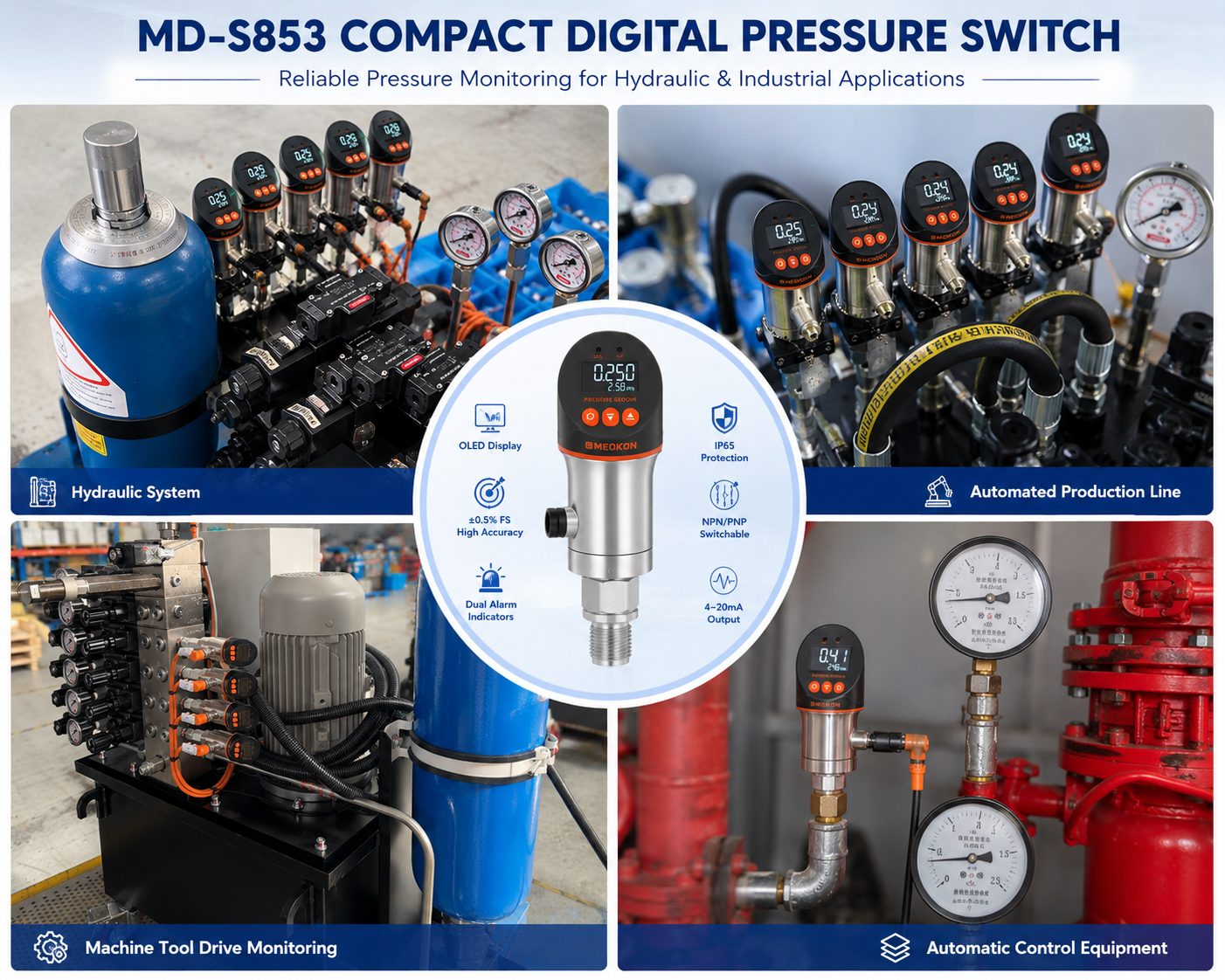
This article analyzes the technical specifications and application logic of the MD-S853, a prime example of a next-generation Digital Pressure Controller. We will explore how its specific design features—ranging from OLED visualization to stainless steel housing—address critical pain points in machine tool drive monitoring and automated production lines.
Key Takeaways
- Precision & Visibility: The shift from mechanical pointers to OLED screens eliminates parallax errors and improves readability in low-light hydraulic cabinets.
- Durability: IP65-rated stainless steel housing is critical for resisting coolant, oil, and dust in machining environments.
- Integration: Flexible outputs (NPN/PNP and 4-20mA) allow seamless connection with PLCs and industrial controllers.
Technical Core: Engineering the MD-S853
To understand why the MD-S853 stands out as a Hydraulic Pressure Switch, we must look beyond the marketing terms and examine the engineering decisions regarding materials, interface, and signal processing.
1 Material Science and Environmental Protection
Hydraulic systems often operate in environments contaminated with metal shavings, coolant mist, and hydraulic oil. The MD-S853 utilizes a 304 Stainless Steel housing. In materials engineering, 304 stainless steel is the standard for corrosion resistance, offering superior protection against oxidation compared to standard carbon steel or plastic housings found in lower-tier sensors.
Combined with an IP65 structural design, the unit is dust-tight and protected against water jets from any direction. This is not merely a rating; it is a physical necessity for components mounted directly on hydraulic manifolds or injection molding machines where wash-downs occur.
2 The OLED Interface Advantage
Traditional pressure switches rely on LED segment displays or mechanical needles. The MD-S853 integrates an OLED (Organic Light-Emitting Diode) screen.
- Contrast & Viewing Angle: OLEDs provide high resolution and wide viewing angles without backlight bleed. This ensures that a technician can read the exact pressure value (with a display accuracy of ±0.5% FS) from oblique angles, which is common in cramped machine interiors.
- Rotatable Structure: The unit features a dual-segment rotating structure. This mechanical design allows the screen and electrical connections to be oriented independently. In panel building, where cable routing space is tight, being able to rotate the housing to align cables without obscuring the display is a significant installation advantage.
3 Signal Output and Logic Control
As a Digital Pressure Controller, the MD-S853 is designed for logic integration. It features:
- Switching Outputs: It supports both NPN and PNP outputs, which are switchable. This versatility allows the sensor to interface with a wide range of PLC inputs (sourcing or sinking) without requiring external relays.
- Analog Transmission: The inclusion of a 4-20mA output (Output 3) allows the device to function simultaneously as a transmitter. This enables the control system to monitor the continuous pressure curve, not just the on/off state, facilitating predictive maintenance algorithms.
Applications & Solutions in Hydraulic Systems
The transition from mechanical to digital monitoring is most evident in three specific industrial sectors: Machine Tools, Automated Production Lines, and General Hydraulic Equipment.
1 Machine Tool Drive Monitoring
In CNC machining, hydraulic pressure drives spindles and clamps.
- The Challenge: Coolant and vibration often destroy mechanical switches. Furthermore, “chatter” or pressure spikes can cause false triggers in sensitive electronic switches.
- The MD-S853 Solution: With a response time of 50ms and robust 304 stainless steel construction, the switch withstands the physical abuse of the shop floor. The OLED screen allows operators to instantly verify clamping pressure without stopping the cycle, ensuring the “High” and “Low” alarm limits are correctly set to prevent part slippage.
2 Automated Production Lines
Modern assembly lines rely on pneumatics and hydraulics for actuation.
- The Challenge: Space constraints. Sensors are often mounted in “blind” spots where cables are hard to reach.
- The MD-S853 Solution: The M12x1 connector is an industrial standard for quick disconnects, reducing downtime during replacement. The dual alarm lights provide immediate visual status (e.g., Green for OK, Red for Alarm) to line operators walking past the machine, acting as a visual management tool (Andon) without needing to check the HMI.
3 Retrofitting Legacy Hydraulic Equipment
Many factories are upgrading old machinery to Industry 4.0 standards.
- The Challenge: Old mechanical switches provide no data. They are binary (open/closed) and offer no diagnostic capability.
- The MD-S853 Solution: By replacing a mechanical switch with this Digital Pressure Controller, the machine gains an analog 4-20mA signal. This data can be fed into a SCADA system to log pressure trends over time, allowing maintenance teams to predict pump degradation before a catastrophic failure occurs.
Comparative Analysis: Mechanical vs. Digital
The following table illustrates the operational differences between traditional mechanical switches and the MD-S853 digital solution.
| Feature | Traditional Mechanical Switch | MD-S853 Digital Pressure Switch |
|---|---|---|
| Display/Readout | Pointer (Prone to parallax error) | OLED Digital Display (High Resolution) |
| Accuracy | ±2.0% to ±4.0% FS | ±0.5% FS (High Precision) |
| Housing Material | Plastic or Coated Metal | 304 Stainless Steel (Corrosion Resistant) |
| Output Signal | Relay (On/Off only) | NPN/PNP Switching + 4-20mA Analog |
| Adjustability | Screwdriver adjustment (Mechanical) | Button Programming (Digital Hysteresis) |
| Lifespan | Limited by mechanical spring fatigue | Solid-state (High cycle life) |
Implementation Guidelines
When specifying the MD-S853 for your hydraulic system, consider the following configuration parameters to ensure optimal performance:
- ✅ Pressure Range Selection: Ensure the selected range (e.g., 0-10MPa or 0-40MPa) allows the working pressure to sit in the middle 50% of the sensor’s capacity for maximum linearity.
- ✅ Output Logic: Verify if your PLC input is PNP (Positive Switching) or NPN (Negative Switching). The MD-S853 is switchable, but it must be configured correctly during commissioning.
- ✅ Thread Compatibility: The unit supports various threads (G1/4, M20, etc.). Always use a torque wrench during installation to prevent stripping the stainless steel threads, especially when mating with softer aluminum manifolds.
- ✅ Electrical Protection: The unit features anti-reverse connection protection. However, ensure the 12-28V DC power supply is clean and regulated to avoid noise interference on the 4-20mA signal.
Frequently Asked Questions (FAQ)
Q How does the IP65 rating impact the installation location of the switch?
A The IP65 rating indicates that the MD-S853 is dust-tight and protected against low-pressure water jets from any direction. This allows the switch to be mounted directly on hydraulic power units or machinery frames where it may be exposed to coolant spray or wash-down cleaning. However, it is not rated for submersion (IP67/IP68), so it should not be placed underwater.
Q Can the MD-S853 replace a 4-20mA pressure transmitter?
A Yes. The MD-S853 is a hybrid device. It functions as a Digital Pressure Controller with switch outputs for alarms/interlocks, but it simultaneously provides a 4-20mA analog output. This allows it to replace two separate components (a switch and a transmitter) in many applications, reducing installation points and cost.
Q What is the benefit of the “Dual-Segment Rotating Structure”?
A In hydraulic manifolds, the orientation of the pressure port is fixed. Often, this forces the display to face a wall or the floor, making it unreadable. The MD-S853′s rotating structure allows the user to install the sensor into the port and then rotate the head unit (up to 335.4 degrees of adjustment range in the design) so the OLED screen and buttons face the operator, ensuring easy programming and monitoring regardless of the pipe orientation.
Q Is the OLED screen readable in direct sunlight or bright factory lights?
A Yes. OLED technology emits its own light per pixel, offering high contrast ratios. Unlike LCDs which rely on backlights that can be washed out by strong ambient light, the OLED screen on the MD-S853 maintains high visibility and resolution even in brightly lit industrial environments, ensuring accurate pressure readings at a glance.
Conclusion & Next Steps
Upgrading to a Digital Pressure Switch like the MD-S853 is not just a component swap; it is a system upgrade. By integrating 304 stainless steel durability, OLED visibility, and versatile NPN/PNP + 4-20mA outputs, engineers can solve the chronic issues of reliability and data visibility in hydraulic systems. Whether for a high-speed train hydraulic system or a standard machine tool, the precision of ±0.5% FS ensures that your automation logic is based on accurate physical data.
Ready to optimize your hydraulic controls?
Contact our engineering team today to discuss your specific pressure range requirements or to request a technical datasheet for the MD-S853 series. Let us help you select the right configuration for your next project.
Post time: Oct-30-2026